
Machinery safety and the new EU Machinery Regulation (EU) 2023/1230 – preparing for 2027
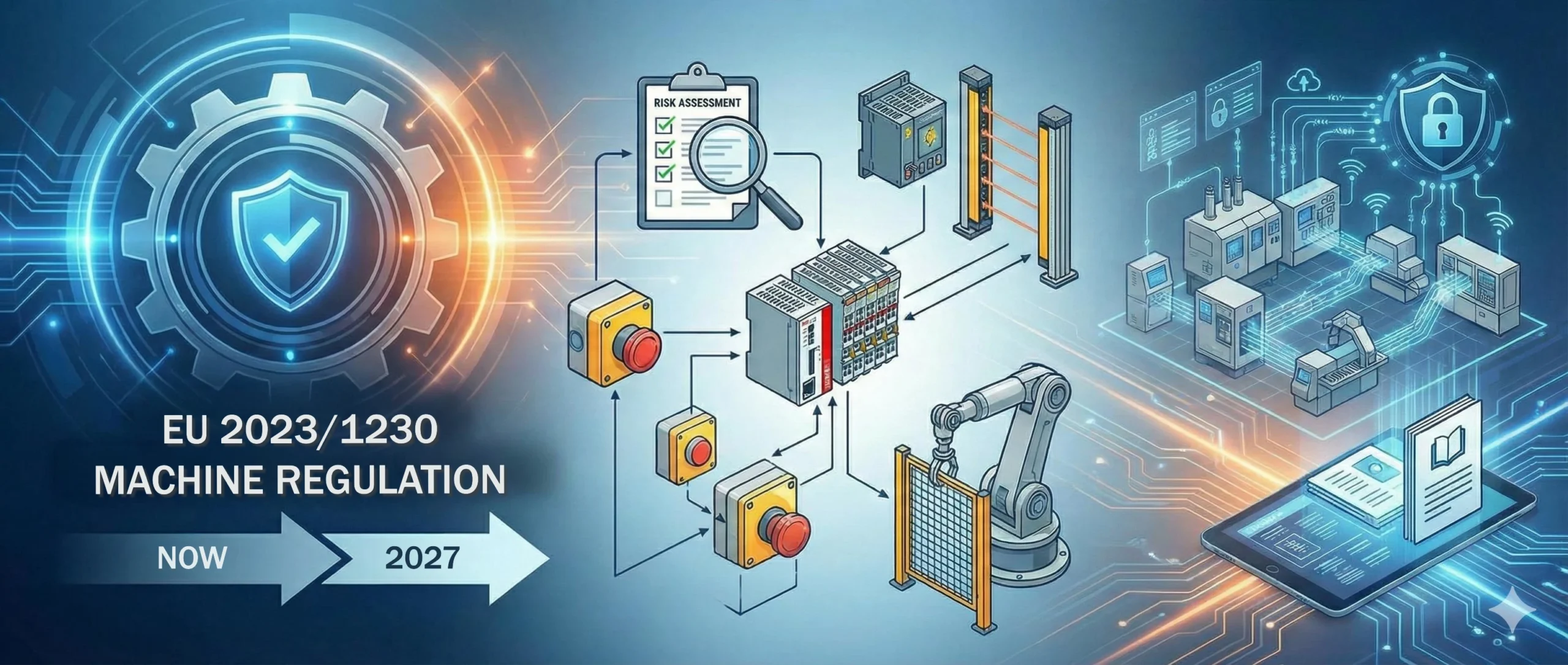
The functional safety of machines, correctly selected protective devices, and carefully implemented safety automation are at the center of the EU Machinery Regulation (EU) 2023/1230. Machines entering the EU market must comply with the requirements of the Machinery Regulation from January 20, 2027.
When design is carried out in accordance with the requirements of the Machinery Regulation and documentation and life cycle thinking are an integral part of the design, the machine supports safe use, maintainability, and production efficiency. At the same time, compliance with the requirements can be clearly demonstrated.
Risk assessment as the basis for operational safety
Risk assessment involves defining the limits of the machine, identifying hazards, and reducing risks step by step. Safety functions are clearly defined and performance requirements are set for them, which are verified through measurements and tests. In addition to meeting the requirements, the reliable operation of safety functions is also ensured in exceptional situations and during installation and maintenance.
Safety devices and safety automation architecture supporting efficiency and safety
When mechanical guards, interlocks, light curtains, safety PLCs, and other safety components are selected and positioned correctly, the machine stops when it should. Well-designed safety devices and safety automation support machine operation, settings, mode changes, and troubleshooting without unnecessary restrictions. At the same time, they reduce the temptation to bypass or override safety devices. A well-designed architecture makes stop chains clear, energy shutdown reliable, and emergency stops unambiguous.
Interfaces in multi-machine systems
Safety challenges often become more pronounced when partially completed machines are integrated into a larger whole. In such cases, interfaces are crucial. Stop and emergency stop chains must function uniformly, and shared operating modes must support both production and maintenance. When the safety of the assembly is designed and validated together, this results in fewer surprises during commissioning and audits.
Documentation as part of safety
The new machine regulation allows for the digital delivery of operating instructions under certain conditions. The instructions must be easy to find, print, and store. In addition, they must be updated throughout the machine’s life cycle as changes are made. Clear and up-to-date documentation makes training, maintenance, and demonstrating compliance much easier.
Cybersecurity in machines connected to the network
Taking cybersecurity into account protects modern, networked machines in particular from cyberattacks and deliberate manipulation. In practice, this requires clear version and change management, restricted access rights, and event logging. When the basics of cybersecurity are handled as part of the normal process, compliance and practical security are ensured at the same time.
Modernization and launch of a new evaluation process
According to the new Machinery Regulation, a significant change triggers a new assessment process. However, not all changes are significant, so in the context of modernization, an assessment is made as to whether the changes increase risk and require new significant protective measures. If this is the case, a new conformity assessment is required. When well planned, modernization can still proceed quickly: assessment, implementation, and documentation are carried out in parallel, and the machine can be put back into service safer than before.
This is how we help
We begin by mapping your machine fleet or product portfolio, identifying risks, specifying safety functions, and ensuring the suitability of protective devices. If necessary, we delve deeper into the safety automation architecture: we define safety requirements, dimension performance levels, and carry out validation. We also produce clear and audit-ready documentation, which we increasingly deliver in digital form. If the machine is connected to a network, we build a lightweight but sufficiently functional cyber foundation that supports safety. In modernization cases, we conduct an impact assessment and, if necessary, carry out a new conformity assessment without unnecessary delays.
Book a free appointment
Want to make sure your products or machinery are ready for the Machinery Directive that comes into effect on January 20, 2027? Book a free 30-minute meeting with us. You will receive a concise overview of how to strengthen functional safety, protective devices, and safety automation solutions, as well as how to implement documentation to ensure smooth operation and auditing.
Contact an expert and book an appointment

Samuli Remes
firstname.lastname@ouda.fi